Cambodian Etiquette & Culture: An Expat's Quick Guide
Facts checked 4 October 2026 — The greeting, monk, shoes, head/feet and communication guidance was checked on 4 October 2026 against the Cultural Atlas (SBS), the University of Washington's EthnoMed Cambodian profile and Commisceo Global's Cambodia guide; temple dress and behaviour rules were cross-checked against the APSARA National Authority code of conduct and Angkor Enterprise's visitor pages. This is general cultural guidance, framed as such, not an official ruling on any individual situation.
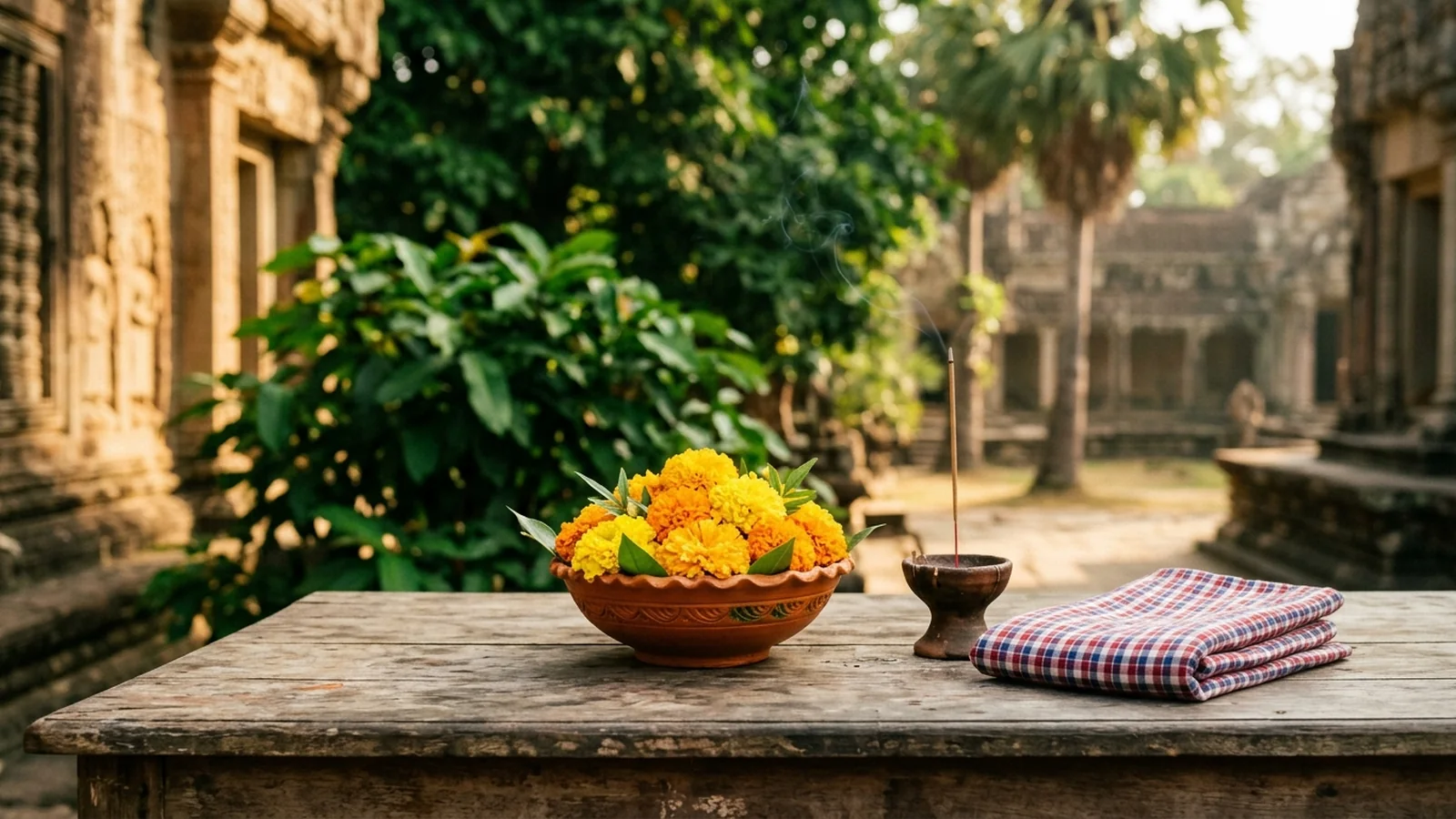
Nobody expects a new arrival to get everything right. Cambodians are famously forgiving of foreign missteps, and the standard reaction to a well-meant error is a smile, not a lecture. What matters is the direction you are moving in — toward calm, modesty and respect. This is a short, practical orientation to the customs that come up most often when you live here, drawn from credible cultural references and Cambodia's own official temple rules rather than from folklore.
The sampeah: the greeting you will see everywhere
The traditional Khmer greeting is the sampeah (សំពះ), also romanised as sompas or sompeah: the palms are pressed together in a prayer-like gesture with a slight bow, and both the height of the hands and the depth of the bow signal the level of respect. Palms at chest level suit peers; hands raised higher and the bow deepened show respect to elders, teachers and monks. It is used to greet, to thank, and to apologise.
As a foreigner, you are not expected to master the levels. A simple chest-level sampeah, or a respectful nod with a smile, is entirely appropriate — and if someone offers you a sampeah, it is polite to return it. Handshakes are common in professional and urban settings, so the safe rule is to follow the other person's lead. The spoken greetings are chum reap sour (hello) and chum reap lear (goodbye).
In temples: dress first, then behaviour
Cambodia's temples are living religious sites, and the visitor rules are set by the APSARA National Authority. Dress is the first filter: shoulders and knees covered, no tank tops, vest tops or short shorts, and no skirts above the knee. A scarf draped on for a moment is not treated as sufficient coverage — the fix is simply to arrive dressed for the setting, which also keeps you cool in light cotton.
Beyond dress, the code asks visitors not to touch carvings, lean on or climb the monuments, or sit on fragile structures. Keep your voice down, and do not walk into or photograph a space where people are praying as though it were a stage set. Unauthorised drone flight is prohibited, and smoking and littering are not permitted.
Monks hold a high place in Cambodian society, and a few points are worth remembering. Women should not touch a monk or hand something directly to one — place the item within reach, or pass it through a man. When seated near a monk, avoid sitting higher than him, and keep your head lower rather than higher. Modest, quiet behaviour is the whole of the etiquette here.
Shoes, heads and feet
Two body rules cause most of the quiet friction. The feet are considered the least clean part of the body, so avoid pointing the soles of your feet at people or at Buddha images, do not use a foot to move or indicate something, and do not step over someone sitting or lying down. When you sit on the floor, tuck your feet to one side.
The head is the opposite — the most sacred part — so do not touch another person's head, including a child's. When you give or receive anything, use your right hand, or both hands, especially with an older or more senior person; the left hand is considered less clean.
Shoes come off before entering a home, a temple, and many shops and guesthouses. It is a small habit to build, and getting it right is noticed.
Photographs: ask first
Cambodian people are generally relaxed about being photographed, but the courtesy is universal: ask first. A raised camera and a questioning gesture, or the phrase som thlai ruup ("may I take a photo"), is enough, and the answer is sometimes no — particularly for monks, elders, or people at prayer. Never treat a person as an attraction, and skip the practice of paying children or villagers to pose.
There is also a formal layer. Personal photographs and phone snapshots around Angkor need no permit, but commercial photography, professional film and drone work require prior permission from APSARA and, in many cases, a fee. If your work is remotely professional, get the permit.
Indirect communication and "face"
Cambodian communication prizes harmony. A blunt "no" can feel confrontational, so it is often softened into "maybe", "we will see", or a polite smile that is not really agreement. Learning to read the pause and the deflection will save you misunderstandings.
Two habits follow from this. First, avoid public criticism and raised voices; losing your temper in front of others costs everyone face and rarely gets you what you want. Second, do not mistake warmth for a signed deal — relationships usually come before transactions, which is why patient, relationship-first dealing works far better than hard negotiation.
Modesty is admired and boasting tends to backfire. Titles and seniority are respected, so addressing someone older or more senior appropriately and showing deference goes a long way.
Cultural humility over a checklist
No list makes you culturally fluent, and treating this one as a scorecard would miss the point. The deeper habit is curiosity with humility: learn a few Khmer words, ask rather than assume, and treat the people you meet as individuals rather than as representatives of a culture. Be thoughtful about history, too — the Khmer Rouge period and its aftermath still shape the lives of older Cambodians, and it is not small talk.
You will get something wrong. You will wear the wrong thing to a temple, or hand a plate with the wrong hand. The response is almost always gentle, and the correct reply is a genuine apology and a correction, not defensiveness.
A quick do-and-don't list
| Do | Don't |
|---|---|
| Cover shoulders and knees at temples | Wear tank tops or short shorts inside |
| Remove shoes and hats at homes and temples | Walk in with shoes on |
| Return a sampeah, or offer a courteous nod | Force a high-level sampeah you have not earned |
| Ask before photographing people | Photograph monks or worshippers uninvited |
| Use both hands to give and receive | Point your feet at people or Buddha images |
| Keep your voice low and your temper in check | Criticise loudly or lose face for others |
Where VillageLife fits
VillageLife is a project in development in Siem Reap. Memberships and crowdfunding are not open yet, and we are not a cultural authority — the sources above, and the people around you, know far more than we do. What we are building is a community of Members who want to live here thoughtfully rather than pass through: a place to share what we learn, get it wrong safely, and do better next time.
Sources
- Cambodian Culture — Etiquette and Communication — Cultural Atlas (SBS, Australia) (checked 2026-10-04)
Cultural-intelligence reference covering the sampeah greeting, gestures, dress and communication norms; used as a primary reference for the greeting and 'face'/indirect-communication sections. - Cambodian — EthnoMed cultural profile — University of Washington, EthnoMed (checked 2026-10-04)
Health-context cultural profile of Cambodian communities (Harborview Medical Center, UW); used to corroborate the sampeah gesture and its use in greeting and respect. - Doing Business in Cambodia — Cambodian Culture Guide — Commisceo Global (commercial consultancy — lowest-weight source in this article) (checked 2026-10-04)
Commercial cross-cultural consultancy guide. Used only to corroborate the hierarchy, 'face' and indirect-communication points that are led by the Cultural Atlas (SBS) and the University of Washington's EthnoMed profile — it is not a public or academic source, so it carries the least weight of the references here. - Code of Conduct — APSARA National Authority (checked 2026-10-04)
APSARA's official Angkor visitor code-of-conduct downloads; source for temple dress, behaviour and the prohibitions on touching/climbing monuments and on unauthorised drones. - FAQs — Angkor Enterprise (official ticket office) (checked 2026-10-04)
Official visitor FAQ linking to the Angkor code of conduct and stating the movement/entry rules visitors are held to.
Sources were opened and checked on the date shown. Rules, prices and services change: confirm the current position with the operator or authority before you rely on a detail.