Cambodia Visa Guide for Expats and Nomads
Facts checked 4 October 2026 — Entry-visa terms, ports of entry and the e-Arrival requirement were checked against Cambodia's official e-Visa platform and Australian Government travel advice on 4 October 2026. Extension fees could not be confirmed from an official source on that date and are deliberately not quoted.
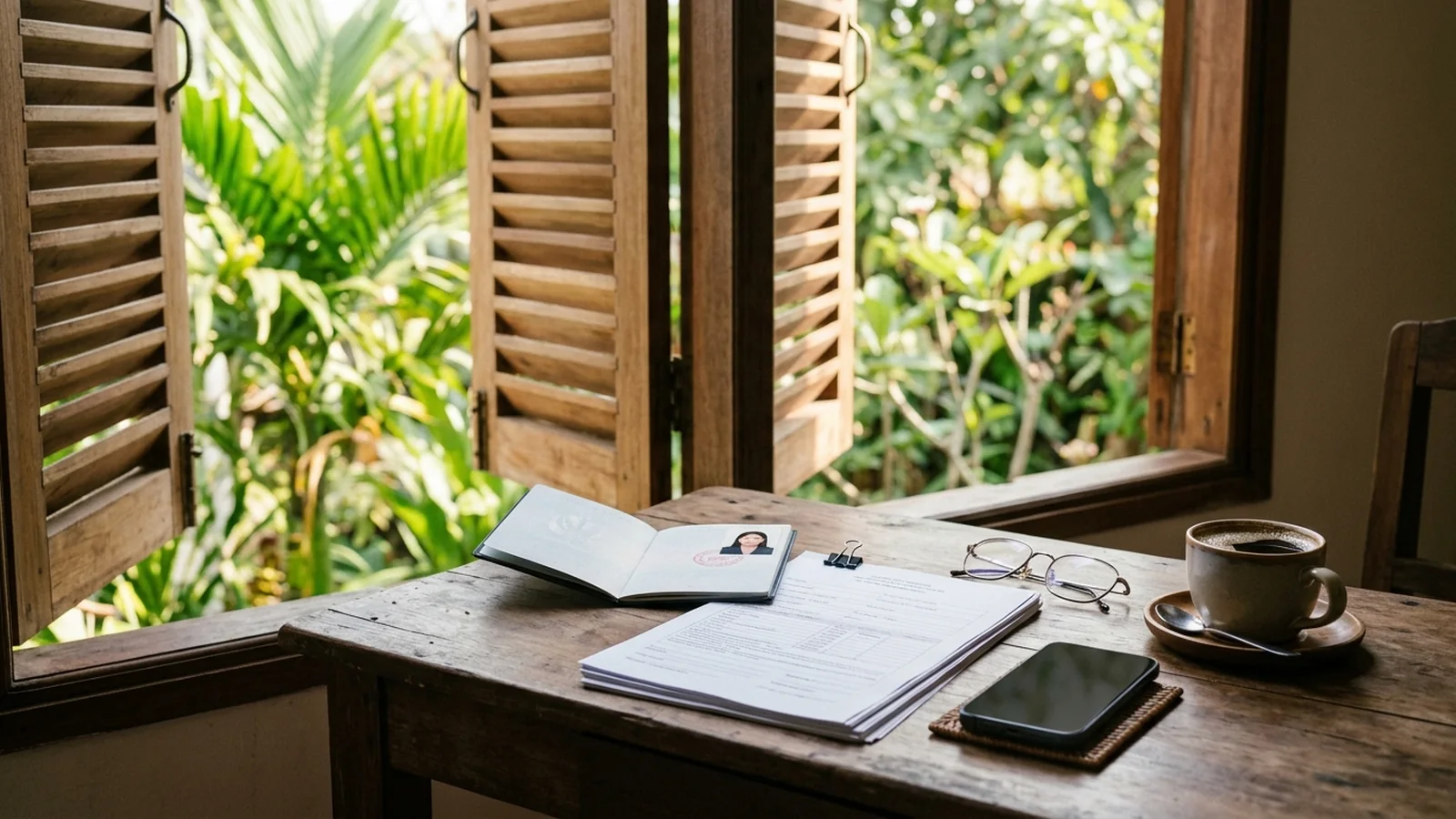
Three different permissions get mixed together in most conversations about moving to Cambodia: the arrival declaration, the visa that lets you enter, and the permission that lets you stay longer. If you plan to work, there is a fourth. They are issued through different processes, and confusing them is how people end up with a problem at the airport or a fine three months later.
Here is how the pieces fit together, based on Cambodia's official e-Visa platform and government travel advice checked on 4 October 2026 — plus a clear note on the two things we could not confirm from an official source, so you know exactly what to verify before you rely on it.
Before you fly: the e-Arrival form
Cambodia's e-Arrival is a digital arrival declaration, not a visa. It does not give you permission to enter; it records how you are arriving. According to the official e-Visa service, it is required for all travellers, including visa holders, and should be submitted online within seven days before arrival, through the government's e-Arrival portal at arrival.gov.kh.
Practically: submit it once your flights are ticketed and before you check in for the flight to Cambodia. It speeds up entry, and doing it at the departures gate on airport wifi is a needless source of stress.
The tourist visa (T): the short-stay default
The published terms on the official e-Visa service, as checked on 4 October 2026:
- Fee: USD 30
- Entry type: single entry
- Validity: 3 months
- Length of stay: 1 month
- Processing: 3 business days
You apply online at evisa.gov.kh and receive an approval letter by email. The e-Visa is accepted at these entry points:
- Airports: Techo International Airport (KTI, Phnom Penh), Siem Reap Angkor International Airport (SAI), Sihanoukville International Airport (KOS)
- Land border checkpoints: Bavet (Svay Rieng) and Tropaeng Kreal (Stung Treng)
Two ports are listed as temporarily closed for e-Visa entry, and both are on the north-western border: Cham Yeam (Koh Kong) and Poipet (Banteay Meanchey). Separately, Australian Government travel advice updated on 22 September 2026 states that land border crossings on that route remain closed. If your plan depends on entering overland there, treat it as unavailable until official advice says otherwise and plan to fly.
For Siem Reap specifically, you will arrive at Siem Reap Angkor International Airport (SAI), which sits roughly 50 km from the town centre. Budget for the transfer as a normal part of arrival rather than a surprise.
A tourist visa is for tourism. It is the right answer for a holiday and the wrong answer for a life here, and it is not a practical route into a long stay.
Staying longer: the ordinary visa (E)
This is the distinction that matters most. Tourist visitors take a T visa. People planning a longer stay — working remotely, starting a business, taking a job locally, or retiring — take the ordinary "E" visa instead, obtained on arrival or arranged in advance through a Cambodian embassy or consulate.
Two honesty notes. First, we verified the T visa's published terms above, but we could not open an official page publishing the E visa's current fee and validity on 4 October 2026, so we are not going to quote a number and present it as fact. Second, the E visa is an entry permission. It is the starting point for a longer stay, not the long stay itself.
If you are weighing up the two: fly in on the visa that matches your actual intention. Changing course after arrival is harder, slower and more expensive than choosing correctly at the start.
Extensions: what we can and cannot confirm
Extensions are applied for inside Cambodia, through the General Department of Immigration or a licensed visa agent, before your current permission to stay expires.
We could not confirm current extension fees or validity periods from an official source on the date of writing. Agent websites quote figures that do not agree with each other, and a fee copied from a marketing page is not a fact. So instead of a number, here is the process that does not depend on one:
- Decide your purpose before you arrive — work, business, retirement, volunteering or long-stay tourism all lead to different extension eligibility.
- Gather your documentation early: passport with at least six months' validity, a passport photo, and proof of a Cambodian address.
- Apply before your permitted stay expires, allowing time for processing. Late is expensive; overstaying carries daily fines and can escalate to detention and deportation.
- Use an official channel or a licensed agent, and ask for the fee in writing before you hand over a passport.
If anybody promises a "guaranteed one-year visa", treat that as marketing rather than a plan. Eligibility depends on your nationality, your purpose and your documentation, and no agent can guarantee an outcome the immigration department has not yet decided.
Work authorisation is a separate permission
This is the expensive misunderstanding. Permission to stay and permission to work are different things. An extension can let you remain in Cambodia without giving you the right to work, and working on a tourist visa is not a grey area — it is illegal.
Work authorisation for foreign nationals is handled through the Ministry of Labour and Vocational Training (mlvt.gov.kh), normally with your employer involved, and it depends on having a registered employer or business. Because the requirements and fees change, confirm the current process with the ministry or a licensed agent rather than a blog — including this one. If a job is the reason for your move, get the work-authorisation question answered in writing by the employer before you book flights.
A practical checklist
- Passport with at least six months' validity and blank pages
- e-Arrival submitted within seven days of travel, before you fly
- Visa route decided deliberately: T for a holiday, E if you plan to stay or work
- One or two passport photos
- Proof of a Cambodian address ready if you will extend
- A phone screenshot and a printed copy of your e-Visa
- Money access arranged in advance — see our guide to banking in Cambodia
- An unlocked phone and a plan for a local SIM
- A written answer from your employer if you intend to work
- Travel plans that tolerate a three-business-day e-Visa processing window
Where VillageLife fits
VillageLife is a project in development in Siem Reap. Memberships and crowdfunding are not open yet, and we are not an immigration service — we cannot advise you on your individual case, and we will not pretend otherwise. What we can do is design the practical side of arriving and settling in: documented connectivity, dependable power, a workspace, and a community to land in. Work out your visa with the authorities; arriving into a place that already works is the part we are building.
Sources
- Cambodia e-Visa (official government service) — Ministry of Foreign Affairs and International Cooperation of Cambodia (checked 2026-10-04)
Visa T: fee USD 30, single entry, validity 3 months, length of stay 1 month, processing 3 business days; list of entry ports; temporarily closed ports; e-Arrival required for all travellers within 7 days before arrival. - Cambodia e-Arrival portal — Kingdom of Cambodia (checked 2026-10-04)
Official portal for the digital arrival declaration. The site is a JavaScript application; the requirement itself is stated on evisa.gov.kh. - Cambodia travel advice and safety — Australian Government, Smartraveller (checked 2026-10-04)
Page updated 22 September 2026 and current at 4 October 2026: visa required; e-visa or tourist visa on arrival valid 30 days; longer stays through a Cambodian embassy or consulate; land border crossings on the north-western border remain closed. - Ministry of Labour and Vocational Training — Kingdom of Cambodia (checked 2026-10-04)
Ministry responsible for foreign work permits and employment cards. Requirements and fees change; confirm current process with the ministry or a licensed agent. - Bakong, National Bank of Cambodia — National Bank of Cambodia (checked 2026-10-04)
Referenced for the money-access step in the checklist; the practical banking detail is covered in our banking guide.
Sources were opened and checked on the date shown. Rules, prices and services change: confirm the current position with the operator or authority before you rely on a detail.