Getting Around Siem Reap: Grab, PassApp & Scooter Rentals
Facts checked 4 October 2026 — Ride-hailing availability, the airport shuttle and helmet rules were checked on 4 October 2026 against Smartraveller travel advice (updated 22 September 2026), the airport's own English transport page, and Grab's and PassApp's own websites. No fares are published because no official fare schedule could be verified; the one figure mentioned is clearly labelled an estimate.
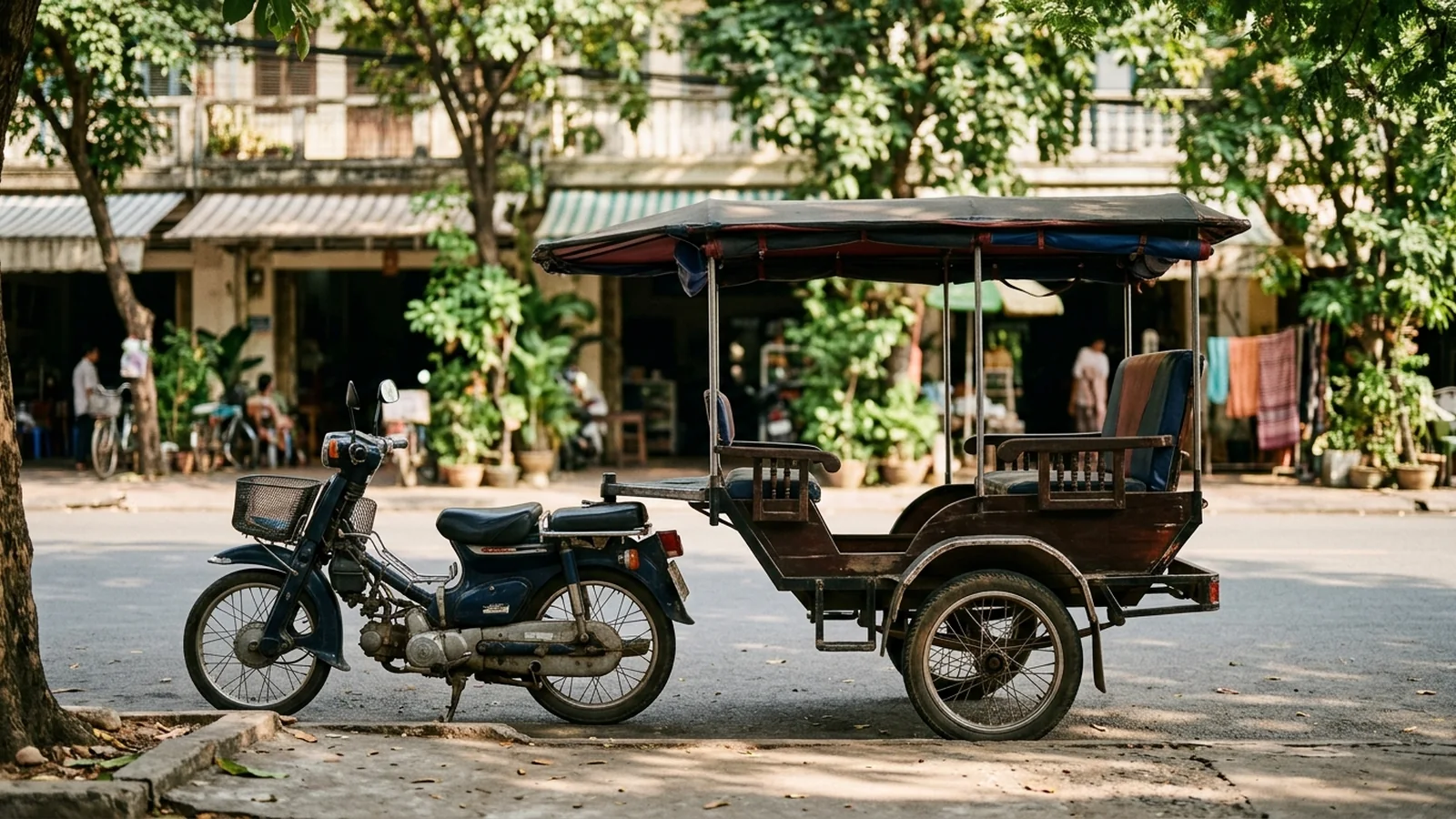
Siem Reap is a flat, compact town where most of your daily trips take under ten minutes, and almost all of them can be done in an app-hailed tuk-tuk. The one journey that catches visitors out is the airport: Siem Reap Angkor International Airport (SAI) sits about 50 kilometres from town, so the transfer is a real trip, not a hop. Get those two facts straight and getting around here is straightforward.
Transport you can trust
Cambodia's ride-hailing scene is dominated by two apps, and both operate in Siem Reap. Australia's Smartraveller service names Grab and PassApp as common in Siem Reap, Phnom Penh, Sihanoukville and Kampot, and describes them as often safer than a flagged-down taxi, motorbike or tuk-tuk.
Grab is the regional app many travellers already know, and its own site confirms it operates in Cambodia, offering cars, tuk-tuks and motorbike rides. It quotes a fixed fare in the app before you confirm, and depending on the option shown at check-out you can pay in cash or by a linked card.
PassApp is Cambodian and, on its own site, offers rickshaws, tuk-tuks, classic cars and SUVs, with the price shown through the app. It is popular with locals and is often described as the cheaper of the two for tuk-tuk trips. Payment is normally cash to the driver, so keep small US dollar notes and riel ready.
Both work the same way for a rider: set pickup and drop-off, see the price, accept, and share the trip. The single biggest benefit is that the price is agreed before you move — no negotiation, and no "the place you asked for is closed, I take you somewhere else" detour.
What a ride costs
We are deliberately not publishing a table of invented fares. The reliable rule is that the app shows you a price in US dollars or Cambodian riel before you confirm, and that price is what you pay. As orientation only: short trips across the town centre are inexpensive, longer cross-town runs cost more, and the airport transfer is by far the priciest local journey. For the airport specifically, the airport's own English transport page confirms an official shuttle bus operates but does not publish a fare, and third-party guides commonly quote about US$8 one way — treat any figure you read online, including that one, as an estimate to verify on arrival.
Getting to and from SAI airport
SAI is roughly 50 km from the town centre, and the drive usually takes about 45 to 60 minutes depending on traffic. Your options:
- Official airport shuttle bus, confirmed on the airport's own site. Typically the cheapest fixed option; note where the town terminus is and how you will cover the last leg to your accommodation.
- Pre-booked private transfer (car or minivan). The most predictable choice for a first arrival with luggage, especially at night.
- Taxi or ride-hailing. Confirm availability and the meeting point before you rely on it, because app coverage at the airport can be thinner than in town.
Leave a generous buffer for a departure, and remember the airport is not walkable from town.
Scooters and e-bikes: freedom, and the rules that come with it
Renting a scooter or e-bike is how many longer-stay residents get around, and rentals are easy to arrange. But two things are commonly misunderstood, and both can cost you.
Helmets are compulsory in Cambodia for riders and passengers — including children from about three years old — under the Road Traffic Law, as road-safety organisations report it, and enforcement has tightened. Police checkpoints are common, especially in tourist areas. Wearing a helmet is the single best thing you can do for your own safety on roads where traffic is mixed and rules are loosely followed.
Licences and insurance are not a formality. Accounts of the letter of the law vary, but the practical picture is consistent: for bikes under 125cc an explicit licence requirement is often not enforced, though carrying an International Driving Permit (an IDP, issued under the 1949 Geneva Convention, which Cambodia recognises) is strongly advised; for motorbikes of 125cc and above you should hold a valid motorcycle licence from home plus an IDP. The critical point is insurance — most travel and health insurers will only cover you in a crash if you held the correct licence and permit for the vehicle you were riding. Ride unlicensed and you may be uninsured, leaving you personally liable for medical bills and damage. Police can also fine you for missing documentation or a missing helmet.
Before you rent: photograph existing damage, get the rental agreement in writing, check the brakes and lights, and confirm a helmet is included. Avoid riding at night and never after drinking.
The legal and insurance reality, stated plainly
Cambodia's roads are the biggest everyday risk a longer-stay resident faces. Smartraveller notes that fatal road accidents, particularly on provincial highways, are common. That is not a reason to stay home, but it is a reason to choose a car over a motorbike for night trips, to wear a helmet every time, and to make sure your licence, your permit and your insurance all line up before you ride. A scooter is a tool with real risk attached; decide deliberately, not by default.
A day-one transport checklist
- Install Grab and PassApp and set up a payment method before you land.
- Save your accommodation's location in both apps, in Khmer if you can.
- Pre-book an airport transfer for a first arrival, or plan the shuttle and the last leg.
- Keep small US dollar notes and riel for cash fares.
- If renting a scooter, bring or arrange an IDP, confirm insurance cover, and always wear a helmet.
Where VillageLife fits
VillageLife is a project in development in Siem Reap. Memberships and crowdfunding are not open yet. We are not a transport company, but the practical side of a longer stay is exactly what we are designing around — a walkable base, dependable connectivity for booking rides, and a community that shares the local knowledge (which driver, which route, which rental place is honest) that makes getting around easier for Members. The choices on the road are still yours.
Sources
- Cambodia travel advice and safety — Australian Government, Smartraveller (checked 2026-10-04)
Page updated 22 September 2026: Grab and PassApp are common in Siem Reap, Phnom Penh, Sihanoukville and Kampot and are often safer than a flagged-down taxi, motorbike or tuk-tuk; fatal road accidents, particularly on provincial highways, are common; avoid travelling at night. - Grab Cambodia (official website) — Grab (checked 2026-10-04)
Confirms Grab's ride-hailing, food and delivery services operate in Cambodia. - PassApp Taxis (official website) — PassApp (checked 2026-10-04)
Confirms PassApp is a Cambodian ride-hailing service; describes booking rickshaws, tuk-tuks and cars and showing the fare through the app. - Transport & Directions — Siem Reap Angkor International Airport (SAI) (checked 2026-10-04)
The airport's own English page confirms an official airport shuttle bus operates and outlines landside transport; no fare is published on the English page.
Sources were opened and checked on the date shown. Rules, prices and services change: confirm the current position with the operator or authority before you rely on a detail.