What to Pack for Cambodia: The Modern Nomad Checklist
Facts checked 4 October 2026 — Plug types and voltage were checked against World Standards' country list (updated 7 September 2025); health, medication, water and temple-dress advice against Australian Government travel advice (updated 22 September 2026); visa and arrival documents against Cambodia's official e-Visa service, all on 4 October 2026.
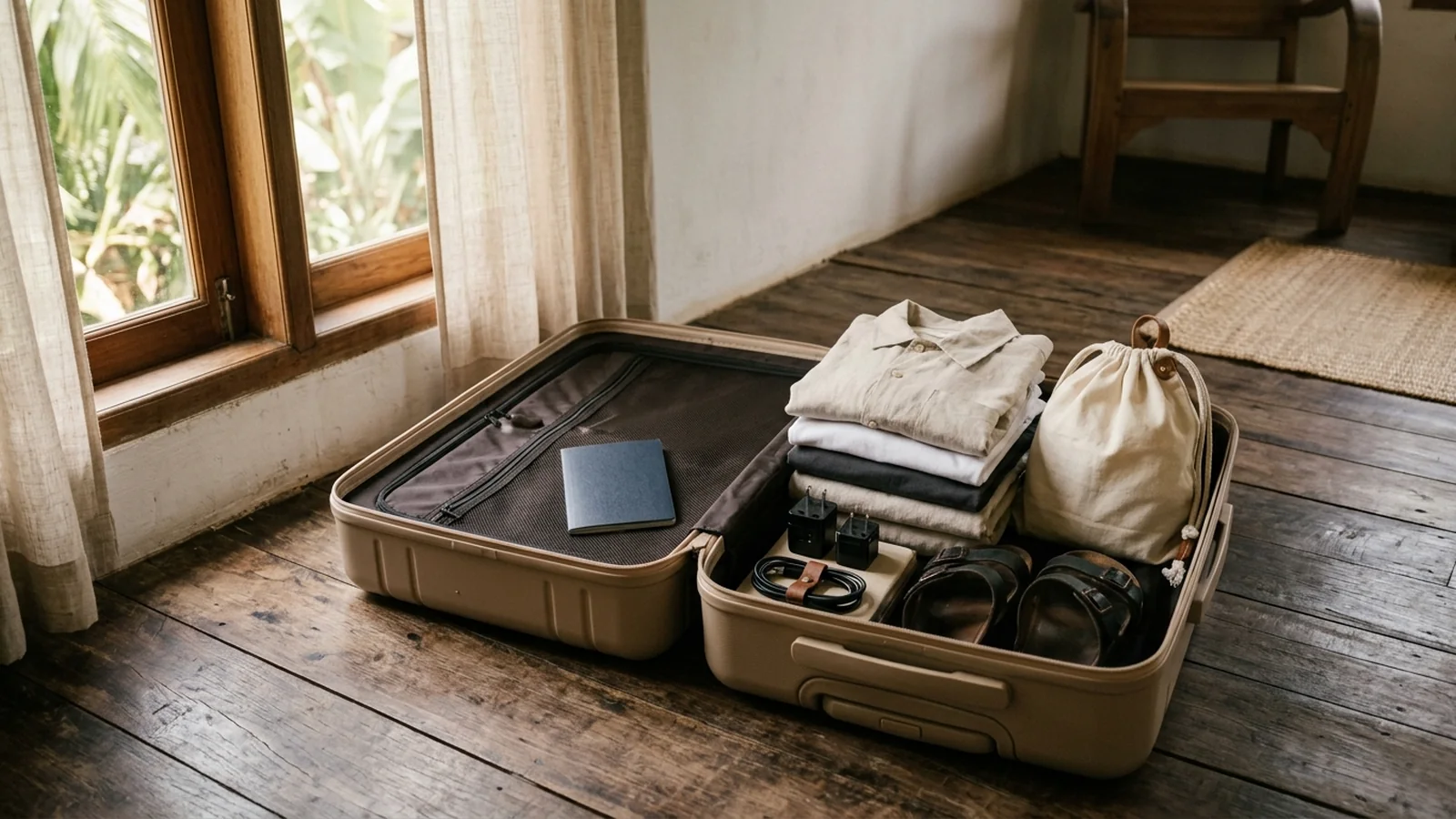
The instinct is to pack for a holiday and then regret it, because a long stay in Cambodia is not a beach trip — it is moving into a hot, humid, cash-and-QR, 230-volt country where a lot of what you feared you would need is genuinely easy to buy. The right list is short and specific: the documents you cannot replace, the electronics that need to match the power, the clothing that respects a temple, and the medication you should not gamble on locally. Everything bulky and generic can wait until you arrive.
Documents and backups first
Paperwork is the one category where "I'll sort it there" is a bad plan.
- Passport with plenty of validity left — Smartraveller notes a passport and visa are required to enter.
- Your visa, printed and on your phone. If you are arriving on the official e-Visa, carry a paper copy as well as the email.
- The e-Arrival declaration, submitted online before you fly through the government's arrival portal.
- Travel and health insurance documents, plus the emergency number of your insurer.
- A digital and a cloud copy of everything above, and one printed photocopy kept separately from the originals.
- A couple of passport photos, useful for permits and applications.
Devices: unlocked, and matched to 230 volts
Cambodia's mains supply is 230 volts at 50 Hz, and its sockets are the universal kind that accept a mix of plug types A, B, C, F and G. Two practical consequences:
- Unlock your phone before you leave. A network-locked handset cannot take a local SIM, and unlocking at home is far easier than in Siem Reap. Check it is also 5G-capable if you want the best data.
- Read the labels on your chargers. Almost all modern laptop, phone and camera chargers are dual-voltage (marked "INPUT: 100–240V") and need only a plug adapter, not a converter. Older or high-power single-voltage appliances — some hair dryers and straighteners — may need a voltage converter, or are better bought locally. Bringing a device rated only for 110–120 V and plugging it in without one will damage it.
Add a compact universal adapter, or two, plus spare cables. Cambodia's sockets often accept several plug shapes, but a universal adapter removes the guesswork.
Power protection and backup
Power quality and brief outages are a fact of life in the region — the state utility publishes scheduled supply interruptions — so a little protection is worth the space:
- A small surge-protection power strip, ideally one with universal sockets, to protect laptops and phones from spikes.
- A high-capacity power bank for phones during outages and travel days.
- A lightweight travel router is optional; most accommodation provides one, but a personal hotspot on a cheap local data plan is often the simplest backup.
Clothing for heat and for temples
Pack light, quick-drying, and neutral, and plan to do laundry locally.
- Breathable shirts and trousers; linen and technical fabrics beat heavy cotton in the heat.
- One outfit that covers your shoulders and knees. Cambodian authorities enforce modesty rules at religious sites such as Angkor Wat, and the same courtesy applies in pagodas, so a light long-sleeved top and trousers or a sarong earn their place.
- Comfortable, broken-in walking shoes, plus sandals you can slip off — you remove footwear to enter temples.
- A light rain shell for the wet season (roughly July to November), when storms and flooding are possible.
- A sun hat, sunglasses and high-factor sunscreen; the Cambodian sun is strong even in the cool season.
Medication and health paperwork
This is the category to be deliberate about. Smartraveller advises travellers to carry enough medication from home for the trip, noting that local pharmacies may sell fake medication. A few basics help:
- Bring an adequate supply of any prescription medicine in its original packaging, with a copy of the prescription.
- Carry a written list of your medications and allergies.
- Include a small personal first-aid kit: oral rehydration salts, plasters, antiseptic, pain relief and any specific remedies you trust.
- For anything serious, remember that hospital stays can be expensive and that insurance should cover medical costs — travel with cover in place.
- Drink only boiled or bottled water; a reusable bottle with a filter is useful, and don't swim in fresh water.
What is genuinely easy to buy in Siem Reap
Do not overpack the everyday items. In and around Siem Reap you can readily buy:
- SIM cards and top-up from operator shops for Smart, Cellcard and Metfone.
- Plug adapters, cables, power banks and phone accessories.
- Basic clothing, sandals, toiletries and umbrellas at the central markets and shops.
- Over-the-counter basics and pharmacy items — though check the medication caveat above for anything you rely on.
What is harder to replace is the specific: your prescription, your well-fitted shoes, a device rated for 230 V, and your documents.
The short version
- Take: passport and visa, printed and digital; e-Arrival; insurance; prescription medicine and prescriptions; unlocked 5G phone; 100–240 V chargers; universal adapter; surge-protected strip; power bank; light clothing with one temple-appropriate set; sunscreen and rain shell.
- Leave: the 110 V-only appliances, the heavy wardrobe, and the "just in case" extras you can buy in an afternoon.
Where VillageLife fits
VillageLife is a project in development in Siem Reap. Memberships and crowdfunding are not open yet, and we are not a retail or relocation service. What we are designing is a settled base with documented connectivity, dependable power and a shared workspace — presented as planned rather than as available. Pack for your own trip; the setup you land into is what we are working on.
Sources
- Plug, socket & voltage by country — World Standards (checked 2026-10-04)
Page last updated 7 September 2025: Cambodia uses plug types A, B, C, F and G at 230 V, 50 Hz, and notes that sockets in the country are universal ones accepting multiple types. - Cambodia travel advice and safety — Australian Government, Smartraveller (checked 2026-10-04)
Page updated 22 September 2026: carry enough medication from home, local pharmacies may sell fake medication; drink only boiled or bottled water; temple dress code requires covered knees and shoulders; a passport and visa are required; land border crossings on the north-western route remain closed. - Cambodia e-Visa (official government service) — Ministry of Foreign Affairs and International Cooperation of Cambodia (checked 2026-10-04)
Official e-Visa service; the tourist visa is USD 30 and the e-Visa should be carried as a printed and digital copy. Confirm current document requirements before travel. - Cambodia e-Arrival portal — Kingdom of Cambodia (checked 2026-10-04)
Official digital arrival declaration, required in addition to a visa and submitted online before arrival.
Sources were opened and checked on the date shown. Rules, prices and services change: confirm the current position with the operator or authority before you rely on a detail.