Remote Work in Siem Reap: 5G Coverage and Fast Fiber
Facts checked 4 October 2026 — The national 5G launch date, operator base-station counts and Siem Reap coverage were checked against the Telecommunication Regulator of Cambodia's 9 June 2026 announcement and each operator's own site on 4 October 2026. Plan prices and speeds are the operators' published figures on that date; network performance varies by location and was not independently measured.
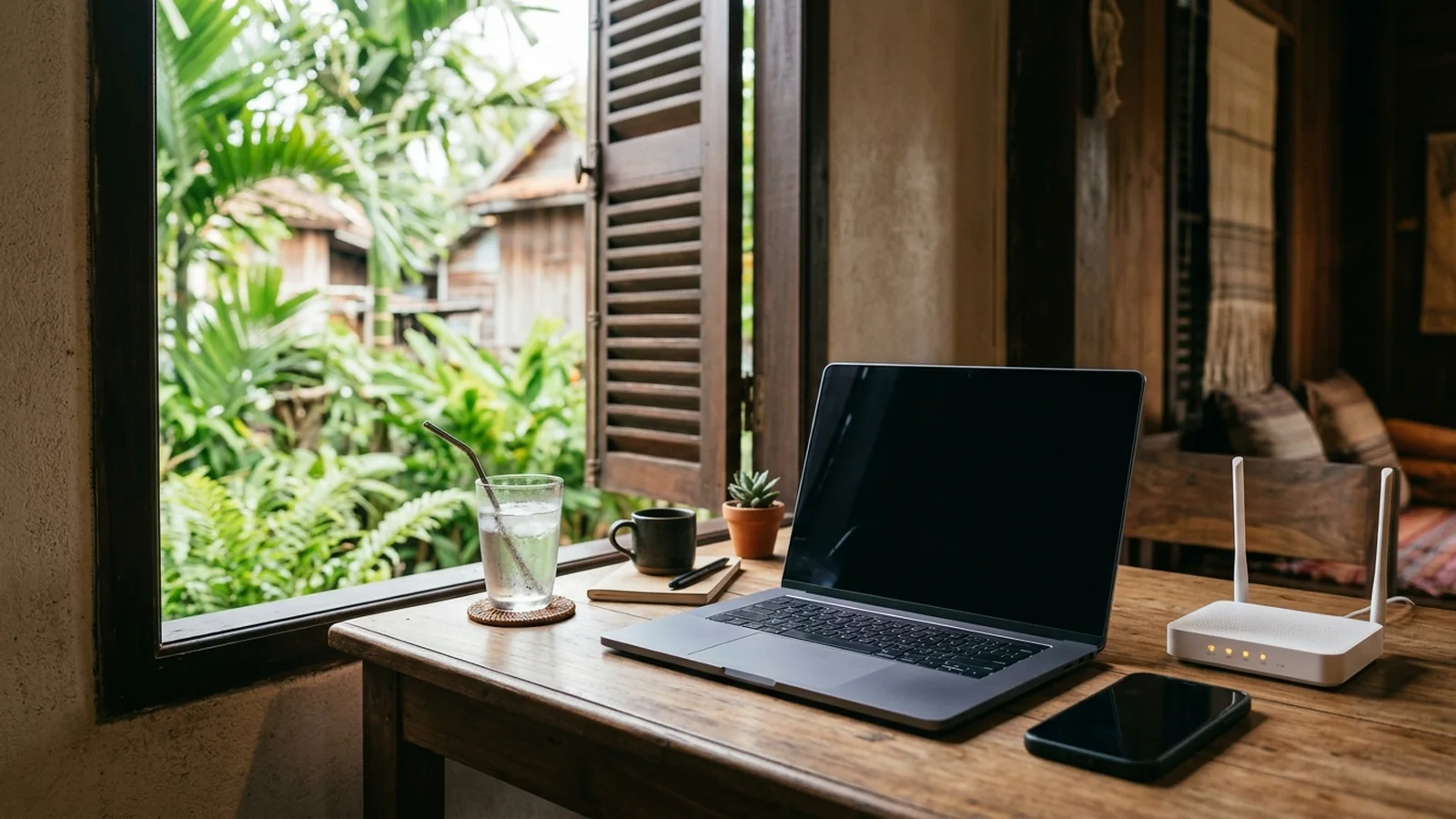
When people ask whether they can work remotely from Siem Reap, the honest answer has two halves. The infrastructure is genuinely good and getting better: Cambodia switched on commercial 5G nationwide on 1 January 2026, all three major operators have sites in Siem Reap, and fibre broadband is widely available across the town. The other half is that advertised coverage and measured performance are different things, and the weakest link is usually power, not the network. Here is what is confirmed, what it costs, and what to check before you commit.
What the regulator confirms
The clearest evidence comes from the Telecommunication Regulator of Cambodia (TRC). In an announcement dated 9 June 2026, the regulator states that, from "the official launch of 5G mobile services on January 1, 2026" to 8 June 2026, Smart Axiata deployed 748 5G base stations, CamGSM (Cellcard) 742 and Viettel (Cambodia) — Metfone — 601, a combined 2,091. Siem Reap is named in all three operators' coverage lists.
So the frequently repeated "5G launched in January 2026" claim holds up against the regulator's own release. That is the strongest confirmation available for a rollout claim, and it is why we are willing to state the date rather than hedge it.
What each operator says
Smart describes its 5G network as "live across 1000+ sites in 23 cities and provinces", with Siem Reap shown among the covered cities, and points customers to a coverage checker and a device-compatibility check inside its SmartNas app. Cellcard's 5G page lists its Siem Reap coverage at commune level — Svay Dangkum — which is useful if central Siem Reap is where you plan to live. Metfone also names Siem Reap among its 5G provinces in the regulator's list.
The practical point: coverage exists in and around the town centre. It does not follow that every guesthouse, side street or villa on the edge of the rice fields has strong 5G indoors.
Plans and SIMs for a new arrival
A 5G phone is the first requirement — a 5G SIM in a 4G handset stays on 4G. After that, prepaid data is cheap by international standards. As published on 4 October 2026:
- Smart 5G Data: 30GB (5G and 4G), 7 days, USD 2.00
- Smart Traveller SIM (sold at airport booths): 30GB, 15 days, USD 5.00
- Cellcard AO MOBILE 5G: 20GB/7 days USD 1.50, 30GB/7 days USD 2.00, 90GB/30 days USD 6.00, 150GB/30 days USD 10.00
Prices move and promotions change, so treat these as the published snapshots they are, not permanent rates. Buy from an operator's own shop or a legitimate reseller, and remember that SIM registration in Cambodia requires ID.
Home broadband: wireless 5G versus fibre
For a fixed workspace you have two credible options.
The quick one is 5G-based wireless broadband, which needs no cabling. Smart's 5G @Home plans, published on 4 October 2026, start at USD 15 for 500GB and rise to USD 22 for 2,000GB over 30 days, each quoting "up to 200Mbps" alongside a stated 25Mbps minimum — a useful, honest floor rather than a single peak figure.
The other is fibre to the building. Cellcard's AO WiFi Fiber is a fixed-line optical service offered on a 12-month contract with a free modem on loan and a public IP on higher tiers; installation is free within one kilometre. Fibre generally gives steadier latency than wireless for video calls, which is why many long-stay residents prefer it where the building already has it.
Advertised maps are not measured speed
Be careful with coverage maps. "1000+ sites" and a shaded province tell you a network exists somewhere near you; they do not promise a particular speed at your desk at 8pm with three other people streaming. Operators publish advertised ranges, not measured results, and indoor coverage in a concrete-walled guesthouse can be far weaker than the street outside. The Ministry of Post and Telecommunications publishes a national Speed Test app that measures download, upload, latency and jitter, and the regulator points users to it: if a measurement shows unusable service, you can report it to the Telecommunication Regulator of Cambodia with the result as evidence. Use a real measurement in your own room before you sign anything.
Video calls and the real work test
For video meetings you do not need enormous speed — you need consistency. A stable connection of roughly 10Mbps down and 5Mbps up with low jitter carries HD calls comfortably; the failures people notice are dropouts and latency spikes, not headline numbers. So test for stability, not just speed: run a call at the hour you will actually work, and assume you need a backup. Keep a phone with a data plan as a hotspot fallback — the mobile networks do not depend on your building's line.
Power is part of connectivity
A fast line is useless in a blackout. Cambodia's state utility, Electricité du Cambodge, publishes scheduled supply-interruption notices on its own site, and the wet season (roughly July to November) brings storms and flooding that can disrupt services. Before you commit to a long lease, ask how the building handles an outage.
Questions to ask any accommodation
- Is the internet fibre, wireless, or shared with the whole building?
- What speed do you actually get in this room, at 7pm, on a video call?
- Is there backup power — generator, UPS or inverter — for the router and a light?
- Can I restart or reach the router myself, or do I depend on the office?
- Is there a quiet space for calls, and a second option if this one fails?
Where VillageLife fits
VillageLife is a project in development in Siem Reap. Memberships and crowdfunding are not open yet, and we are not a telecoms provider. What we are designing is exactly the resilience layer this article keeps pointing at: the connectivity and power layer we are designing set up for remote work, presented as planned rather than as available. Verify your own line before you rely on it; we will keep working on the rest.
Sources
- Announcement on Progress of the Construction and the Provision of 5G Mobile Services in Cambodia — Telecommunication Regulator of Cambodia (checked 2026-10-04)
Dated 9 June 2026: 5G officially launched 1 January 2026; by 8 June 2026 Smart had 748 base stations, CamGSM 742 and Viettel (Metfone) 601; Siem Reap named in all three operators' coverage lists. - Smart 5G — Smart Axiata (checked 2026-10-04)
'5G is live across 1000+ sites in 23 cities and provinces'; Siem Reap shown among covered cities; coverage and device checks via the SmartNas app. - Smart 5G @Home — Smart Axiata (checked 2026-10-04)
Wireless 5G home broadband: Chill 500GB USD 15, Pro 1000GB USD 18, Stream 2000GB USD 22 per 30 days; maximum 200Mbps, minimum 25Mbps. - cellcard 5G — Cellcard (CamGSM) (checked 2026-10-04)
5G plan prices (AO MOBILE 5G from USD 1.50); Siem Reap coverage listed at commune level (Svay Dangkum). - cellcard AO WiFi Fiber — Cellcard (CamGSM) (checked 2026-10-04)
Fixed fibre broadband on a 12-month contract with a free modem on loan; installation free within 1 km; public IP on higher tiers. - Smart Traveller SIM — Smart Axiata (checked 2026-10-04)
30GB data, 15-day validity, USD 5; sold at international-airport booths. - Electricité du Cambodge — Electricité du Cambodge (checked 2026-10-04)
State electricity utility; publishes scheduled supply-interruption notices (checked 4 October 2026). - Cambodia travel advice and safety — Australian Government, Smartraveller (checked 2026-10-04)
Page updated 22 September 2026: severe storms and flooding can occur during the wet season (July to November) and disrupt transport and essential services.
Sources were opened and checked on the date shown. Rules, prices and services change: confirm the current position with the operator or authority before you rely on a detail.