Where to Live in Siem Reap: Neighborhoods and Coliving
Facts checked 4 October 2026 — Administrative names and divisions were checked on 4 October 2026 against Open Development Cambodia's administration reference (district, sangkat and village layers), Cellcard's published 5G coverage listing, and English Wikipedia entries used explicitly as tertiary cross-references. Area characterisations and rental guidance are general advisory description, not quotes or measured claims; no rent figures are stated because none could be verified.
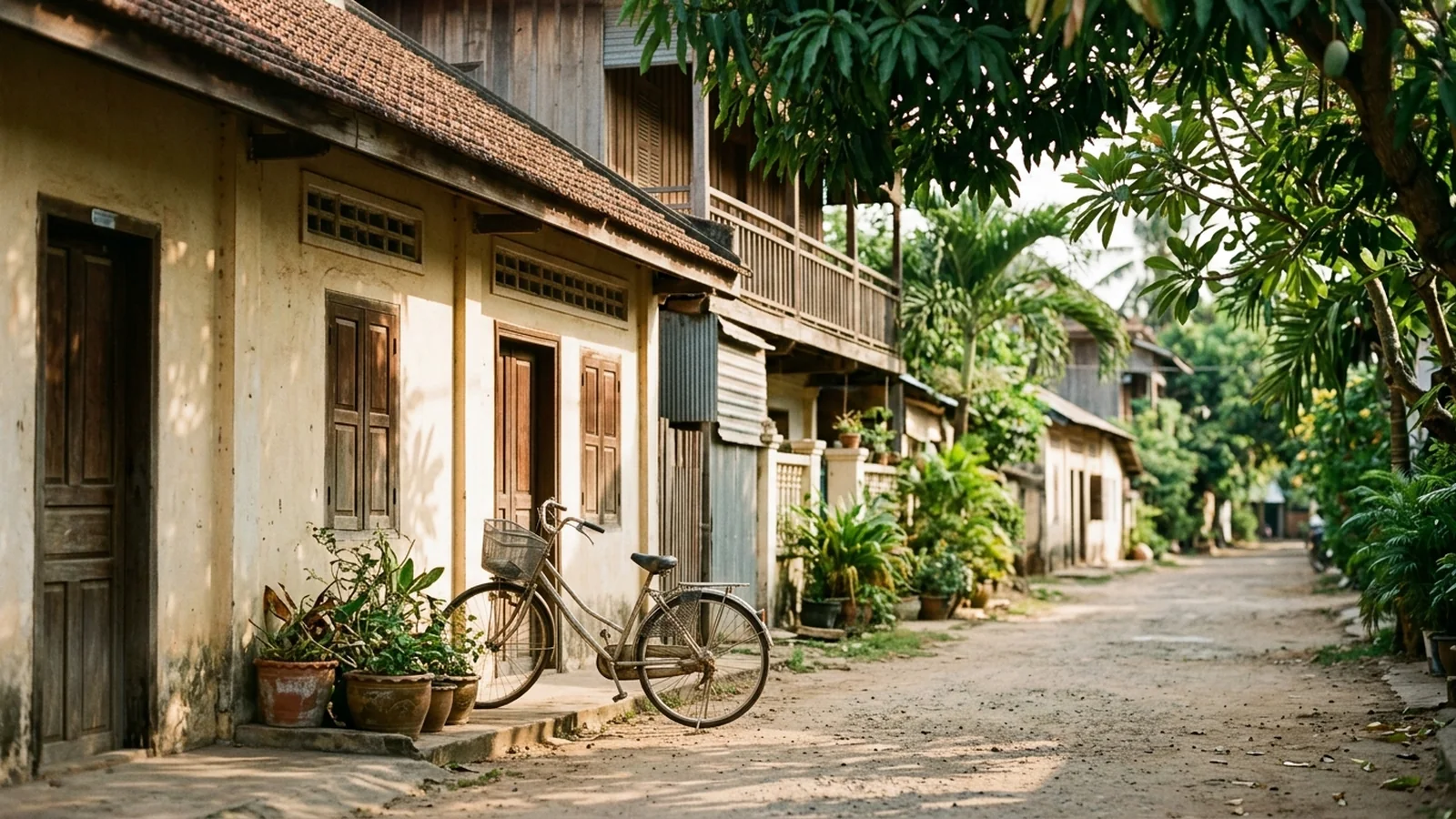
Siem Reap is a small town. You can cross the centre in twenty minutes and learn the main roads in a weekend, so "where to live" is less about avoiding the wrong side of a big city and more about matching a small area to the shape of your day. The names that recur in every rental conversation are the riverside, Svay Dangkum, Sala Kamreuk (including the Wat Bo area) and the National Road 6 corridor. Here is how they relate, what to compare between them, and how to weigh renting on your own against a coliving house.
How the town is organised
Siem Reap city is the capital of Siem Reap province and Cambodia's second-largest city. It sits inside Krong Siem Reap, the municipality, which is divided into roughly a dozen sangkats — the ward-level unit that Cambodian addresses actually use. That administrative layer matters when you rent: a listing that says "Sala Kamreuk" or "Svay Dangkum" is naming a sangkat, and Wat Bo is a village inside Sangkat Sala Kamreuk, not a separate district. When a landlord quotes an address, ask for the sangkat and the nearest landmark — it is a more reliable way to place a property than a street name alone.
The riverside and the old quarter
The Siem Reap River runs through the centre, and the streets around it — the old market quarter, with its French-colonial and Chinese-style shophouses — are the most walkable part of town. This is where restaurants, cafes, galleries and the night market cluster, and where you can live without owning any transport at all. The trade-off is noise and footfall: the closer you are to the market and the riverside bars, the more you will notice late-night sound. Look a street or two back from the riverfront and the character changes sharply.
Svay Dangkum: the centre of the centre
Svay Dangkum is the sangkat most visitors think of as "downtown Siem Reap". It contains the central markets and the well-known Pub Street area, and it is the densest concentration of food, shops and services. Living here means maximum convenience and minimum need for a scooter. It also means the highest ambient noise and the most tourist traffic at peak hours. If your priority is a short walk to everything, this is the area; if you want quiet, it is not.
Sala Kamreuk and Wat Bo
Sangkat Sala Kamreuk spreads along the eastern side of the river and inland, and its villages — Wat Bo, Wat Damnak, Wat Svay and others — are known as some of the more settled, residential parts of central Siem Reap. Wat Bo takes its name from the historic pagoda of the same name, and the area around it mixes local homes, guesthouses, cafes and small shops. For many longer-stay residents this is the sweet spot: still walkable or a short ride from the centre, but calmer in the evening. Rental stock here ranges from budget rooms to renovated townhouses, so the same sangkat can feel quite different from one street to the next.
The National Road 6 and Charles de Gaulle corridor
National Highway 6 is the long highway that runs from Phnom Penh through Siem Reap toward Banteay Meanchey, and its in-town stretch — along with the Charles de Gaulle road that runs toward the Angkor area — forms the spine of the newer, more spread-out parts of the city. Development along this corridor tends to be larger: bigger apartments, newer buildings, hotels, supermarkets and showrooms. It suits people who will have a motorbike or car and value space and parking over walking distance. It is also the corridor most exposed to traffic and, at points, road noise.
What to actually compare
- Convenience: distance on foot to food, a market and a pharmacy. The centre wins; the highway corridor loses unless you drive.
- Noise: riverside and Pub Street areas at night; main-road corridors at rush hour. Visit at 8pm before you sign, not just at midday.
- Transport: do you need a scooter from day one? The centre mostly does not; outer areas mostly do.
- Services: check water pressure, rubbish collection and internet quality street by street — these vary more than the map suggests.
- Flooding: some low-lying streets pond after heavy wet-season rain. Ask neighbours what happens in September and October.
Renting on your own versus coliving
Independent renting through a landlord or agent gives you privacy and control, but you carry every setup task: utilities accounts, internet, furniture, repairs, and the language gap with your landlord. Coliving — a managed house with shared common areas and often bills included — trades some privacy for a lower-effort start: no separate utility accounts, a ready social circle and someone else chasing the plumber. Which is better depends on how long you are staying. For a few months, the lower-friction option usually wins; for a year or more, your own lease often costs less and fits better.
What to inspect before you sign
- Read the lease and confirm what is included — electricity is often metered and billed separately, and it is the biggest surprise on many bills.
- Test the internet in the room and a mobile signal on both major networks.
- Check water pressure and hot water, and whether the bathroom drains properly.
- Confirm how electricity and water are billed, at what rate, and who reads the meter.
- Ask about security: locks, a gate, and who else has keys or access.
- Take dated photos of the condition and any existing damage before you move in.
- Confirm the notice period and whether your deposit is refundable in full.
Where VillageLife fits
VillageLife is a project in development in Siem Reap. Memberships and crowdfunding are not open yet, we have no address and no residential building to point you to, and nothing here describes a VillageLife property. What we are working on is a settled base with documented connectivity, dependable power and a shared workspace, presented as planned rather than as available. Choose your neighbourhood on your own terms; the shared base we are designing is presented as planned, not as available.
Sources
- Administration — Open Development Cambodia (checked 2026-10-04)
Reference platform for Cambodia's administrative structure (province, municipality, sangkat and village levels), used to confirm the administrative layers that the area names in this guide belong to. - Siem Reap — Wikipedia (tertiary cross-reference) (checked 2026-10-04)
City context: second-largest city in Cambodia and capital of Siem Reap province; French-colonial and Chinese-style architecture around the Old Market; the Siem Reap River runs through the town. Used only as a tertiary cross-reference, not as primary evidence. - Siem Reap municipality — Wikipedia (tertiary cross-reference) (checked 2026-10-04)
Administrative structure: the municipality is divided into sangkats including Sla Kram, Svay Dankum and Sala Kamreuk; Wat Bo is listed as a village within Sangkat Sala Kamreuk. Tertiary cross-reference only. - National Highway 6 (Cambodia) — Wikipedia (tertiary cross-reference) (checked 2026-10-04)
National Highway 6 runs from Phnom Penh through Siem Reap towards Banteay Meanchey; source for the highway corridor that crosses the town. Tertiary cross-reference only. - cellcard 5G — Cellcard (CamGSM) (checked 2026-10-04)
Operator's own published 5G coverage listing, naming Siem Reap at commune level (Svay Dangkum), evidencing that commune's place within the urban centre.
Sources were opened and checked on the date shown. Rules, prices and services change: confirm the current position with the operator or authority before you rely on a detail.